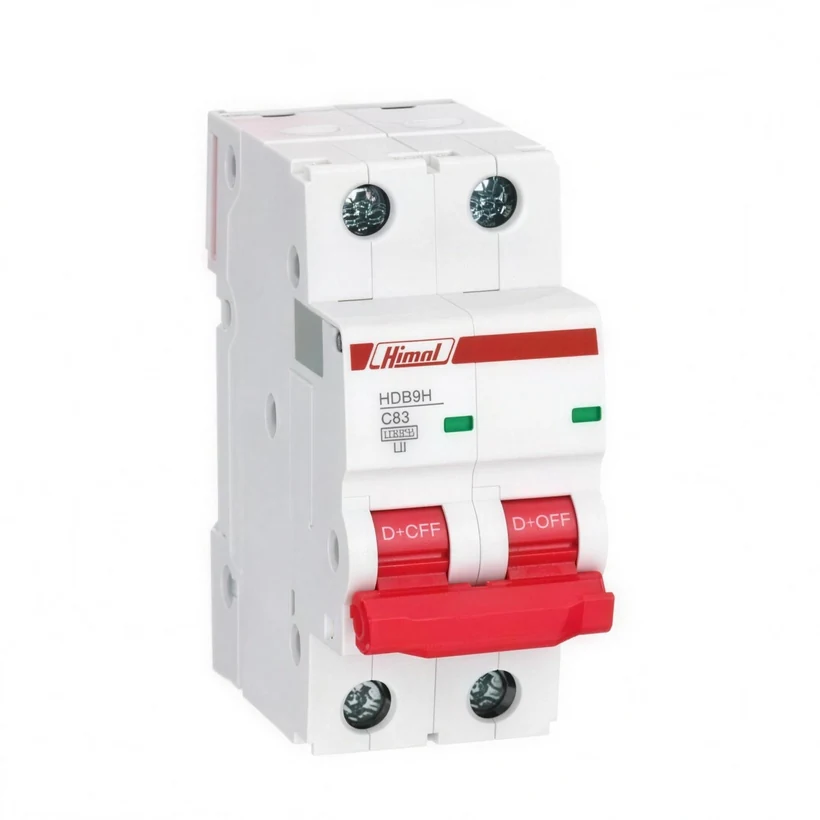
How to Choose the Right Himel HDB9H MCB for Your Project
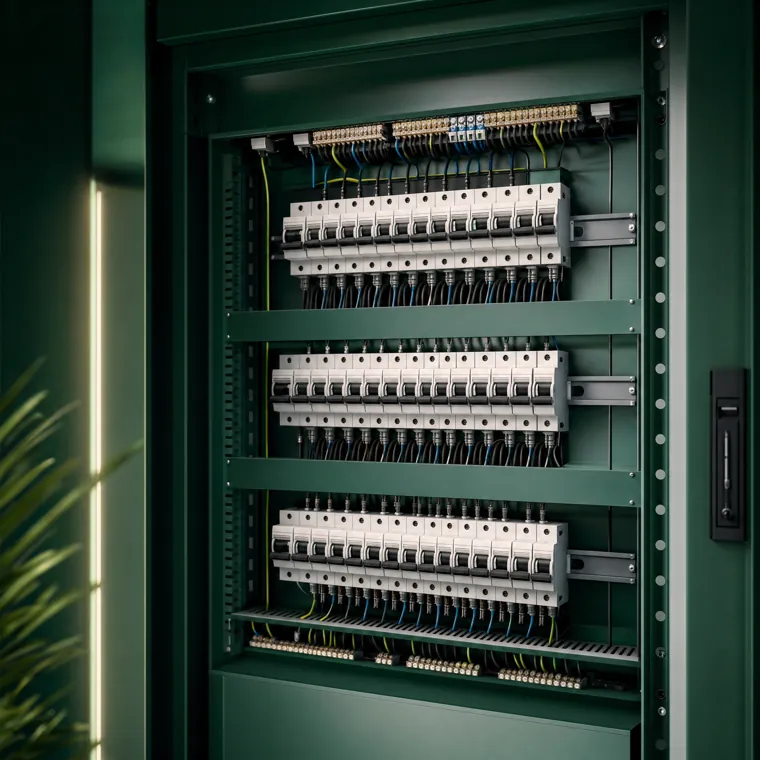
The miniature circuit breaker (MCB) is the most numerous protection device in any distribution board — one per final circuit. Because you buy them by the dozen, it is easy to treat them as a commodity and grab whatever is on the shelf. That is a mistake. Choosing the wrong curve or an under-rated breaking capacity leads to two costly outcomes: nuisance tripping that a facilities team lives with for years, or a breaker that cannot safely clear a fault. This guide walks through how to select the right Himel HDB9H MCB — a high-performance final-circuit breaker built to modern standards — and why the choice matters more than it looks.
What the HDB9H is built to do
An MCB protects a final circuit and its cable against two faults: overload (sustained current above the rating, e.g. too many appliances on one circuit) and short circuit (a sudden high fault current). The HDB9H is Himel's high-performance MCB range, designed to IEC 60898-1 for household and similar installations, with a higher breaking-capacity class that suits Singapore's commercial and light-industrial boards where prospective fault levels are higher than a typical home.
HDB9H at a glance (indicative — confirm exact ratings with Jason)
- Type: high-performance miniature circuit breaker (MCB)
- Poles: commonly 1P, 2P, 3P and 4P
- Rated current: a range spanning roughly 1–63A
- Curves: B, C and D characteristics for different load types
- Standard: designed to IEC 60898-1; higher breaking-capacity class than a basic MCB
Step 1 — Match the rated current to the circuit
The MCB's rated current (In) should sit at or just above the design current of the circuit, and must coordinate with the cable's current-carrying capacity so the breaker protects the cable, not the other way round. Undersize it and you get nuisance trips; oversize it and the cable can overheat before the breaker reacts. Common ratings — 6A, 10A, 16A, 20A, 25A, 32A, 40A, 63A — cover lighting, socket, and small-motor final circuits.
Step 2 — Pick the correct tripping curve (this is the one people get wrong)
The curve defines how quickly the magnetic element trips on inrush/fault current — expressed as a multiple of the rated current:
- Curve B (3–5× In): resistive and low-inrush loads — lighting, sockets, general residential-style circuits.
- Curve C (5–10× In): the workhorse for mixed commercial loads with moderate inrush — small motors, transformers, fluorescent/LED banks. Most commercial circuits use C.
- Curve D (10–20× In): high-inrush loads — larger motors, transformers, and equipment that draws a big magnetising surge at start-up.
Choosing B where you need D causes endless nuisance trips on start-up; choosing D where B is right leaves a circuit under-protected against smaller faults. The HDB9H is available across B, C and D so you can match the curve to the real load.
Step 3 — Confirm the breaking capacity
Breaking capacity (Icn, in kA) is the maximum fault current the MCB can safely interrupt. It must equal or exceed the prospective short-circuit current at that board. This is exactly why a high-performance MCB like the HDB9H matters: in commercial buildings, data centres and industrial sub-boards, fault levels are often well above what an entry-level MCB is rated to clear. Fitting a higher-kA HDB9H gives the margin those installations require — and keeps the board compliant.
Step 4 — Get the poles and accessories right
- 1P for single-phase final circuits, 1P+N / 2P where the neutral is switched, 3P/4P for three-phase loads.
- Specify auxiliary/alarm contacts or add-on RCD/RCBO protection where earth-fault protection is required by the design.
Why a high-performance MCB is worth it
The cost difference between a basic MCB and a high-performance one is small; the difference in reliability and safety is not. A properly specified HDB9H reduces nuisance trips (fewer callbacks, happier tenants), gives the fault-clearing margin that commercial fault levels demand, and — sourced genuine — carries the documentation your as-built pack needs. Cheap or counterfeit MCBs are a false economy that can quietly compromise a whole board.
Get the right HDB9H — from local stock
As an authorised Himel distributor in Singapore, Trans-Digi Global supplies genuine HDB9H MCBs across the full curve and rating range with same-business-day support. Tell us the circuit ratings, load types and fault level and we will confirm the right curve, rating and pole configuration. See the Himel HDB9H MCB product page for the full spec, browse the online shop, or message Jason with your schedule of circuits for a fast quote.